Twenty of the month: September
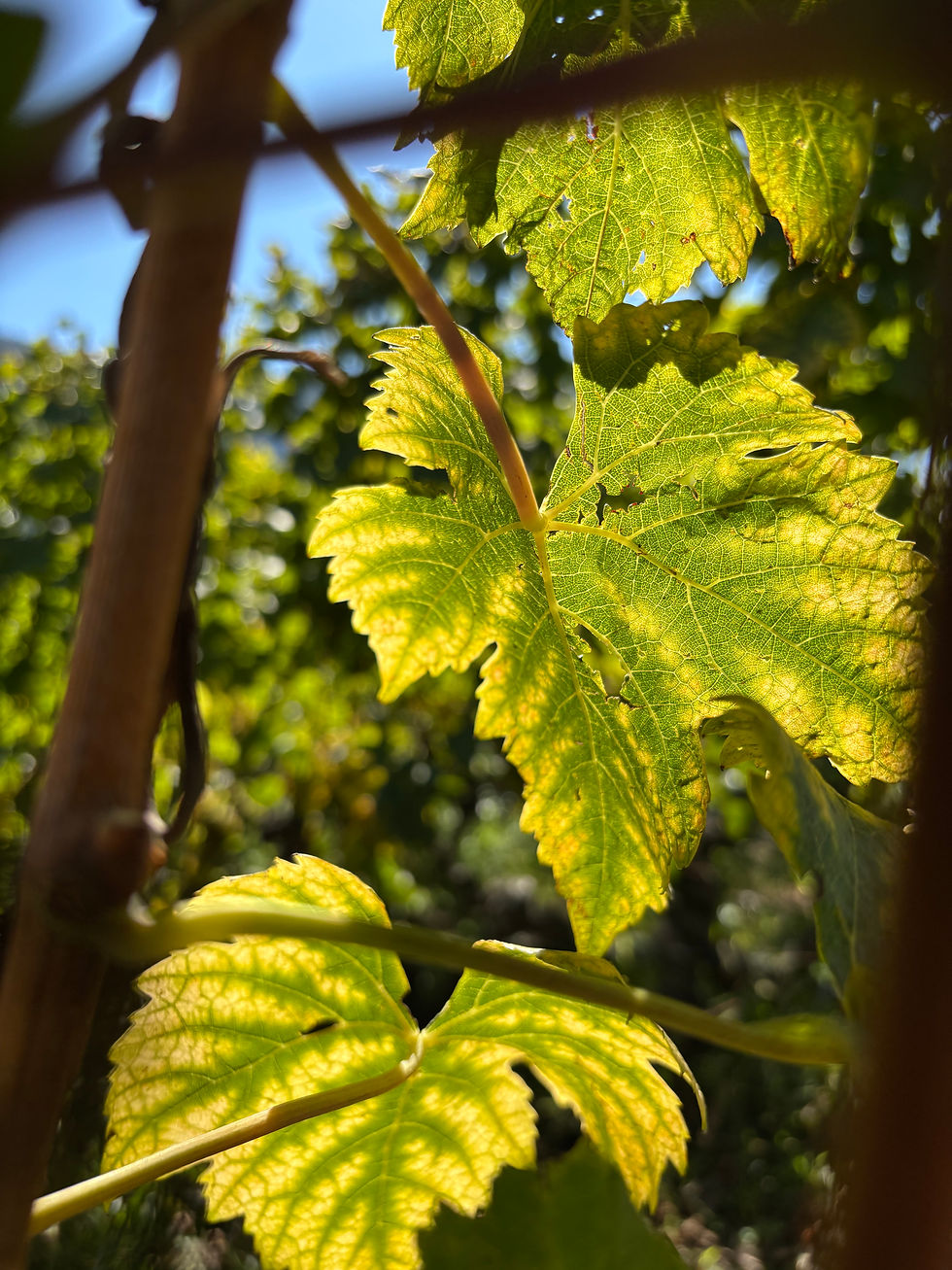
In September, from cool mornings to bright afternoons, everyone is busy.
The vineyard. The 2025 vintage is drawing to a close, its golden grapes carrying with them all the climatic uncertainties and adventures typical of a wine season. From April snowfalls to heat waves while we had to dodge summer thunderstorms, our beloved vines are nearing harvest time and ready to let us taste the fruits of our labor once again. But how do you organize all this when no fewer than 60 tons of grapes need to be harvested?
In the vineyard
To determine the optimal harvest time, you will need a refractometer and sturdy footwear. A refractometer, as it is called in the wine industry, is used to determine the sugar content of grapes. The standard unit of measurement is the Oechsle degree (Oe). The closer the Oechsle value (or Oe value) is to 100, the higher the sugar content and consequently the alcohol content of the grapes.
And why a pair of shoes in particular?
Each grape variety must be checked weekly to determine the sugar content development in the grapes. Pinot Noir, an early-ripening variety, matures very quickly and therefore accumulates sugar in the berries more rapidly, while Humagne Rouge, a late-ripening variety, takes its time. A sample of 100 berries is taken from the entire plot. The extracted juice is then measured with our refractometer. The sugar content increases and the acidity decreases over time.
In the basement
In the basement, we switch into receptionist mode. No ringing phones, but...
Crates full of sweet grapes were stacked in front of the grape mill. That's the
First step. The harvest is placed into this first tool, which separates the spindle and the skeleton.
The remaining berries are removed from the bunch. The stems are removed, as they are often not yet ripe enough.
and astringent, which gives the wine a "green" taste. Are the berries then crushed?
crushed to obtain a mixture of juice, peels and grape skins.
The juice is rich in sugar, while the skin secretes flavonoids (pigments).
yellow) or anthocyanins (red pigments). In the case of a red wine harvest
This mixture is stored separately in the cellar, inoculated with yeast, and then fermentation begins.
alcoholic. We're talking about maceration, which lasts about ten days. The white wines themselves
will go directly to the press and speak for over two hours in two bars.
Under pressure, the pulp is separated from the juice, which is also mixed with yeast and then processed further.
Fermentation.
Wine of the Month
From its crimson color to its peppery aroma and tannic finish, appellations like Hermitage or Côte Rôtie should lead wine lovers to discover Syrah.
Yes! Syrah, a wine whose origin is hotly debated worldwide. It's often associated with the Italian region of Syracuse or even distant Syria. But its true origin lies in France and is closely linked to the Rhône Valley. It's related to other renowned grape varieties such as Viognier, Marsanne, and Roussanne. These latter varieties (all white wine grapes) are frequently blended with Syrah, giving it fruity notes and a smooth mouthfeel. It's one of the few wine regions in the world that permits this art of blending.
But let's head upstream against the current, along the Rhône to Chamoson, the second-largest wine-growing municipality in Switzerland. At the foot of the Haut de Cry, the emblem of the local wines, lies the vineyard, known for its very stony and deep soils, which originate from an alluvial fan of this 3,000-meter-high massif. The roots find their place among the rocks, drawing up the water and minerals essential for the development of our noble grapes. Our Syrah benefits from a climate very similar to that of the northern Rhône, with slightly less sunshine but also less rainfall than the French average. For over twenty years, it has thrived here on our plot "Les Pierres Bénites" (The Blessed Stones).
Syrah thrives in dry soils and hot climates. In Australia, with the accent, a
He calls it "Shiraz".

Tasting of the 2023 La Vouettaz Syrah from Chamoson
Its fur appears clear and red to the eye with violet hues.
A fruity fragrance with notes of red fruits and blackcurrant, underscored by warmer, chocolatey nuances.
On the palate, the wine is smooth and light, yet gives no hint of what awaits. On the contrary, the aromas intensify as you drink, evolving from blackcurrant to blackberry. Spicy notes, including pepper, also emerge, revealing the tannins of the grape variety and lending the wine a crisp and powerful mid-palate. The warm finish lingers long after the last sip.
Licorice and cherry
Article written by Hugo Zufferey.


Comments